
Program for the First " Konferenz Dritte Orte
Tuesday, May 5, 2026
9:30 – 10:00 | Check-in + Coffee
Tuesday | 10:00 a.m. – 10:15 a.m.
Welcome and opening of the conference
Anja Adam, Theater Basel | Anna Kleeblatt, AK. Culture. Marketing, Sales & Service | Benedikt von Peter, Theater Basel | Nelly Riggenbach, Novartis
Tuesday | 10:15 a.m. – 10:45 a.m.
Keynote: Origins of Third Space I
: Come, Stay, Grow: Creating Cultural Spaces That Bring People Together
Aat Vos, included
Why do some places immediately captivate us, invite us to linger, and help us grow together? This lecture explores how public and cultural spaces become true “third places.” Drawing on inspiring international examples, it focuses on how design, programming, and community engagement can transform cultural spaces into places of connection and belonging.
Tuesday | 10:45 a.m. – 11:30 a.m.
Panel 1: Suddenly social? Cultural venues become social venues
Benedikt von Peter, Theater Basel | Prof. Emeritus Dr. Udo Rauchfleisch, Private Psychotherapy Practice, Basel | Adriana Ružek, Schwarzer Peter
Cultural institutions are increasingly taking on social roles—both by choice and out of societal necessity. At the intersection of culture and social issues, new expectations, new responsibilities, and new forms of collaboration are emerging. What opportunities and challenges does this shift bring—and how can cultural venues balance their artistic mission with their social responsibility?
11:30 a.m. – 12:00 p.m. | Networking break
Tuesday | 12:00 p.m. – 12:45 p.m.
Keynote Presentation: Setting Out for the Third Place – From Initiative to Development to Operation
Tobias Bäcker, Third Places Network/pro loco
Whether it’s a cultural institution in a major city or the revitalization of a village pub: “We want to become a ‘third place’!” How can we initiate and shape these processes and developments? What prerequisites must be met, what steps must be followed, and what actually defines a “third place”? This keynote address bridges the gap between urban and rural areas, initiation and further development, municipal cultural institutions, and independent nonprofit projects.
12:45 – 1:45 PM | Lunch + Networking
Tuesday | 1:45 – 2:30 p.m.
Panel 2: Money, money, money – Funding Third Places
Peter Haerle, Consulting and Project Support | Daniel Häni, Unternehmen Mitte | Robert Schmuki, Philanthropist, NPO Process Facilitator | Dr. Reinhard Scolik, Kirch Foundation
Third places need ideas, commitment—and reliable funding. Representatives from foundations, cultural policy, and the field will come together to discuss which models are sustainable, where funding mechanisms reach their limits, and what new alliances are possible. The focus will be on how third places can be financed in the long term without losing their openness and their mission.
Tuesday | 2:30 – 3:15 p.m.
Breakout Sessions 1 – Creating Space (Introduction)
You can attend one of these breakout sessions at 2:30 p.m. and another at 3:45 p.m.; please register via the conference app.
1 | From Project to Mindset – Organizations in Transition
Christina von Rotenhan, rotenhan ADVISORY
Many third places start out as projects—and soon run into obstacles. This is because they transform not only spaces and services, but the organization itself. Using the example of the Foyer Public at Theater Basel, this discussion explores experiences, dilemmas, and the question of what it takes for a project to become an integral part of the organization’s culture.
2 | A Space Without Direction – The Courage to Embrace the Uncurated
Patrick Oes, Theater Basel
What does "uncensored" actually mean in the everyday life of a cultural institution? This workshop explores how much control can be relinquished and what forms of use are permitted. Between risks, opportunities, and gray areas, it's all about rules, trust, and shared responsibility.
3 | Idealism Meets Mammon – Thinking About the Third Place in Economic Terms
Nadine Apperle, Theater Basel
A third place requires vision, but also a viable business model. The workshop will examine business plans, cost structures, and potential financing models. It will also discuss the role of financial management and controlling in the tension between idealism and economic viability.
4 | Designing Spaces for Third Places – The Example of Basel
Walter Reinhard, Department of Construction and Transportation of the Canton of Basel-Stadt
In recent years, various third places have emerged in Basel. What does it take for them to function effectively? How do they benefit the community and the city? Using various examples, their distinctive features and factors for success will be highlighted and discussed.
5 | “This Is Where the Music Plays!” – Community Music and the Role of Modern Cultural Venues
Mika Haasler, Dortmund Concert Hall
How can cultural venues rethink their role in society to strengthen communities? Using both the Konzerthaus Dortmund in Germany and the UK as case studies, this session will explore how community music can provide a way to connect, create, and inspire through music in an increasingly polarized world.
6 | Funding Consortia – Jointly Financing Third Places
Dr. Theresa Gehringer and Andreas Geis, Foundation for Art, Culture, and History | Elisabeth Roos, #TrustMakesAnImpact Initiative
A third place requires vision, but also sustainable funding partnerships. The workshop takes participants on a conceptual journey through the world of funding consortia and, using a brief typology, explores the various ways in which roles, goals, and funding models can be shaped within the tension between oversight and autonomy.
3:15 PM – 3:45 PM | Snacks + Networking
Tuesday | 3:45 – 4:30 p.m.
Breakout Sessions 2 – Creating Space (Introduction)
You have the option of attending one of the breakout sessions at 2:30 p.m. and another at 3:45 p.m.; please see the same list above. Registration is available via the conference app.
Tuesday | 4:30 p.m. – 5:15 p.m.
Panel Discussion on the Tradition of Third Places in Basel: Open Spaces and Basel, Churches, and Corporate Spaces as Third Places
Open Spaces and Basel
Barbara Buser, baubüro in situ
Basel has a long history of open spaces and communal meeting places—even if they weren't referred to as "third places" in the past. This short lecture highlights this tradition and places current developments in this historical context.
The Church as a Third Place
Anne Burgmer, Roman Catholic Church of Basel-Stadt
For centuries, churches were central third places—places of community, exchange, and belonging. Today, many of these spaces are losing their social presence or disappearing altogether. This short lecture highlights their significance and questions their future role.
Corporate Space as a Third Place?
Prof. Emeritus Dr. Ing. Vittorio Magnago Lampugnani
The example of the Novartis Campus in Basel shows how spaces with third-place qualities can also be created in the private sector. The article outlines how architecture, corporate interests, and the public sphere converge here.
Tuesday | 5:15 p.m. – 5:30 p.m.
Briefing on Site Visits
Organizational information regarding the site visits in Basel. Guided city tours of Basel offer a firsthand experience of selected “third places.” The tours provide insights into specific projects and facilitate conversations between participants and the people who shape and develop these spaces. These locations can also be visited individually before or after the conference—as an extension of the program into the urban landscape.
Registration via the conference app; each tour is limited to 25 participants.
Tuesday | 5:30–7:00 p.m. | Meeting place: Theaterplatz
Tour 1 | Theaterplatz Neighborhood – Cultural Institutions in Public Urban Space (EN)
Meret Jaggi, Theaterplatz-Quartier Association
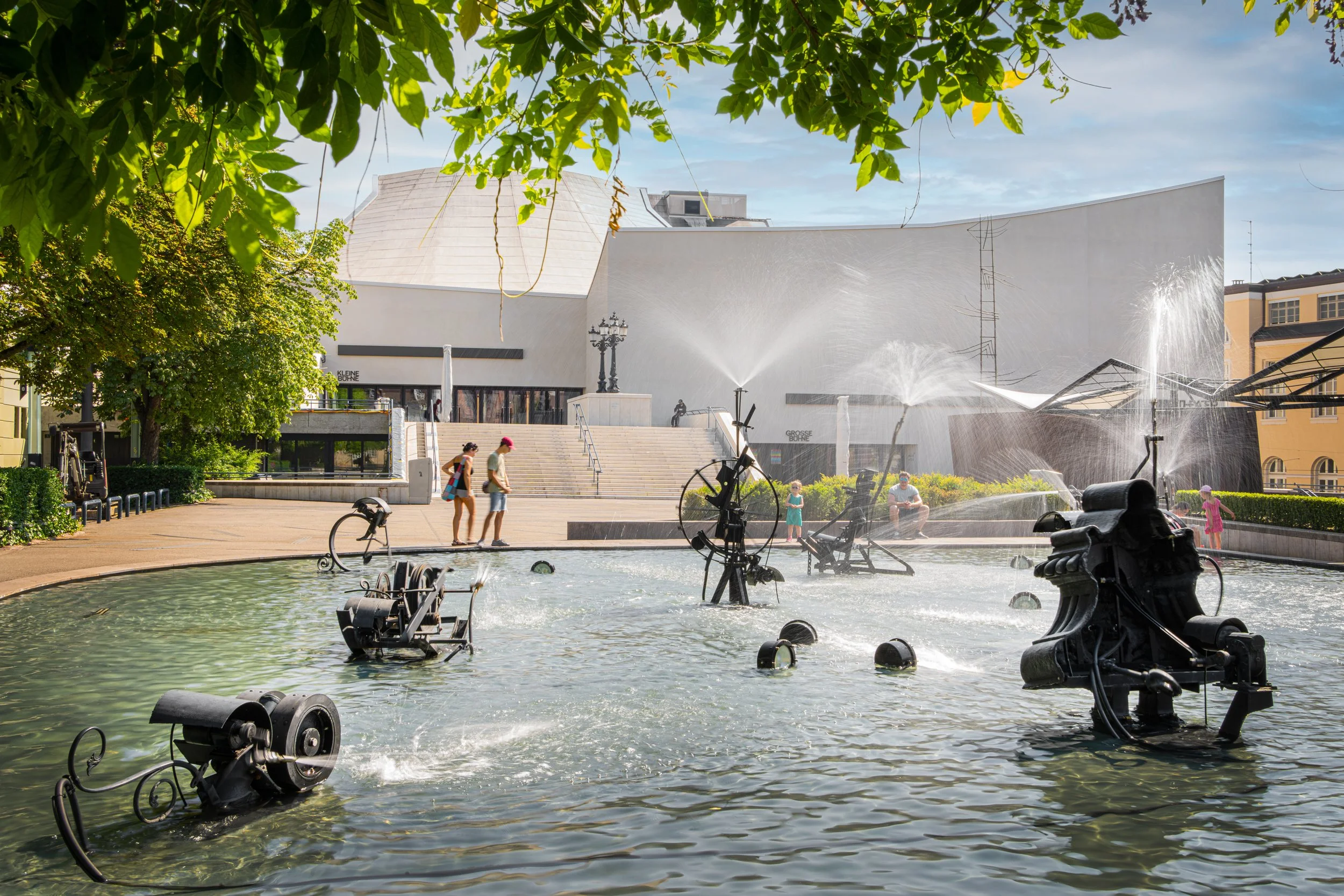
Ten cultural institutions near Theaterplatz have joined forces under the banner of the “Theaterplatz-Quartier” association. Together, they are committed to shaping and revitalizing the public space around Theaterplatz. The tour takes you through the neighborhood and highlights its cultural richness—from the Open Church of St. Elisabeth and SAM—the Swiss Architecture Museum—to the kult.kino (cinema) beneath Jean Tinguely’s Fasnachts-Brunnen. Join the tour and meet the directors of the cultural institutions.
Tour 2 | Theaterplatz District – Cultural Institutions in Public Urban Spaces
Tim Buser, Theaterplatz Neighborhood Walks
Ten cultural institutions in Basel have joined forces around Theaterplatz to form the “Theaterplatz-Quartier” association. Together, they are committed to shaping and revitalizing the public space around Theaterplatz. The tour takes you through the neighborhood and highlights its cultural richness—from the Elisabethen Open Church to the SAM Swiss Architecture Museum and the kult.kino cinema beneath Jean Tinguely’s Fasnachtsbrunnen fountain. The directors of the cultural institutions will be joining you along the way.
Tour 3 | Foyer Public – A Look Behind the Scenes
Marian Cramm, Theater Basel | Thea Stucki, Theater Basel
What is daily life like at Foyer Public? This tour offers insights into the day-to-day operations, from setting up the kids’ corner in the morning to activities and offerings such as mini-massages, ping-pong, the chess club, and family discos, all the way to the role of the AskMe volunteers and interns. At the same time, it becomes clear how the space functions as an open gathering place even without a scheduled program. The connections to theater operations and the associated tensions are also addressed.
Tour 4 | Dreispitz – From Industrial Site to Public Space
Maria Luisa Brooke, Basel Tourism
On this guided tour of the Dreispitz site, you’ll get a firsthand look at urban development. Where the customs-free warehouse once stood, art, education, and the creative industries now define the area. Together, we’ll explore iconic buildings such as the University of the Arts and the Oslo Nord building. The tour provides insight into the area’s development and invites you to reflect on the role of architecture and urban development in shaping new forms of public space.
Tour 5 | How to CIVIC – Where Art Academy Meets the Public (DE/EN)
Matylda Krzykowski, CIVIC | Ligia Tarcea, CIVIC
CIVIC at the HGK Basel FHNW sees itself as a social infrastructure and an open space for discourse and exhibitions. It is a place where students, researchers, and the public come together to share ideas and collaboratively develop new formats. The project team offers insights into this experimental environment and explores how educational institutions can become spaces for exchange and social participation.
Tour 6 | kHaus Plaza – Community Space in the Kasernenareal
Joël Pregger, kHaus
The kHaus in Kleinbasel opened its doors in 2022. It is a cultural and community space for cultural actors, the neighborhood, and the city’s residents. The kHaus offers an easily accessible platform for diverse cultural and social projects. At its heart is the public plaza, a space free of any obligation to consume, where people can meet, linger, or carry out projects. The visit provides insights into the kHaus and its diverse uses, ranging from event spaces and coworking areas to an open lounge area. Together, we will discuss how such places function as social infrastructure and what dynamics emerge when different user groups share a space.
Tour 7 | Unternehmen Mitte – The Coffeehouse as a Cultural Catalyst
Daniel Häni, Unternehmen Mitte
For over 25 years, the Kaffeehaus Unternehmen Mitte has been one of the defining gathering places in downtown Basel. After its acquisition by the Edith Maryon Foundation, a large coffeehouse was established in 1999 in the former lobby of the Schweizerische Volksbank. Co-founder Daniel Häni offers insight into the space, which he sees as a cultural catalyst. For example, the coffeehouse operates—very successfully—without a minimum purchase requirement. It is a third place. A public living room. An agora. A play that never ends.
Tour 8 | GGG City Library – Open Library at Schmiedehof
Julia Wäger, GGG City Library and GGG Schmiedehof
With its Open Library concept, the GGG City Library is setting new standards and serves as a model for many libraries in Switzerland. Following an introduction to the concept and its significance for the development of libraries as third places, participants will explore the main Basel location at the Schmiedehof together. The discussion will focus on how libraries function as open, accessible spaces for diverse user groups and what role they can play for and as third places. As a cooperation partner, the library is making its pop-up library available to Foyer Public, allowing both third places to complement and strengthen one another.
Tour 9 | Union Neighborhood Center – Sociocultural Life in the Matthäus Neighborhood
Gabriel Meisel, Union Neighborhood Center | Anna Trümpy, Union Neighborhood Center
Following a reorientation, Union 2025 reopened as a neighborhood center with a bistro in the Matthäus Quarter. A visit offers insights into the usage concept developed by Denkstatt Sàrl and baubüro in situ as a low-threshold meeting place. How is sociocultural practice actually implemented? From the open neighborhood bistro to the temporary use of the large theater hall by the GGG Library, we will discuss together the opportunities and challenges associated with a transformation process in everyday life.
Tour 10 | Heiliggeistkirche – Neighborhood Church in Gundeli
Anne Burgmer, Roman Catholic Church of Basel-Stadt | Katrin Schulze, Holy Spirit Parish
The Heiliggeist Church was built in 1912 in the Neo-Gothic style as the center of the Catholic parish in the then-growing Gundeldinger neighborhood. Designed by Gustav Doppler and Max and Carl Anton Meckel, the building remains an important landmark in the neighborhood to this day. After more than a century of use and a comprehensive renovation in 2012, the church continues to serve as a religious, cultural, and social gathering place for the Holy Spirit Parish. This visit invites you to reflect on the role of churches as public spaces and places of community in everyday urban life through a conversation with Katrin Schulze, parish minister and deputy parish director of Holy Spirit.
Tuesday | 7:00–8:15 p.m.– 11:00 a.m. | Blackbox
After-party / Get-together in the Foyer Public | Theater Basel
Wednesday, May 6, 2026
9:00 – 9:15 | Arrival + coffee
Wednesday | 9:15 – 10:00
Keynote: Origins of Third Space II
: From Le CENTQUATRE-PARIS to the world – cultural urbanism as a blueprint for cultural spaces
Martin Colomer-Diez, CENTQUATRE-PARIS
Drawing on the experience of Le CENTQUATRE-PARIS, this project explores cultural urbanism as a methodological framework for envisioning, designing, and bringing to life contemporary cultural spaces and art projects in public spaces.
Conceived as a porous and hybrid institution, Le CENTQUATRE-PARIS has, since its opening, embodied a new model of cultural facility: at once a place for artistic production, a platform for international creation, and a shared urban space open to all audiences. Rooted in a former industrial site at the heart of Paris, Le CENTQUATRE-PARIS functions as a living ecosystem where artists, residents, cultural professionals, and visitors intersect on a daily basis. Residencies, creative production, events, public art, amateur activities, early childhood programs, shops, and restaurants coexist within a single architectural and social framework. This constant interaction between art, everyday life, and urban functions forms the basis of a pragmatic and inclusive approach to culture-led urban transformation.
Building on this laboratory-scale experience, the engineering department at Le CENTQUATRE-PARIS has, since 2014, applied this methodology to major cultural projects in France and around the world.
Drawing on the experience of CENTQUATRE-PARIS and the projects led by its engineering team, this talk will explore how cultural diagnostics, strategic positioning, programming, and site-specific artistic interventions can foster the development of hybrid cultural venues that are deeply rooted in their local communities. Artistic and cultural projects can serve as powerful catalysts for enhancing a region’s appeal and driving territorial transformation: they reveal the potential of places and their various uses, bring stakeholders together around a shared vision, and highlight local dynamics.
Wednesday | 10:00 – 10:45
Panel 3: Third Places – Where Are They Headed?
Julia André, Körber Foundation | Andreas Geis, Foundation for Art, Culture, and History | Johannes Küng, Institute for Sociocultural Development, Lucerne University of Applied Sciences and Arts (HSLU) | Tabea Michaelis, Institute of Architecture IAR
Third places are emerging in many places—but who actually designs and runs them? Do these actors come from the fields of culture, architecture, social work, urban development, or entirely different disciplines—and will a distinct professional profile be needed for this in the future? The panel discusses where greater professionalization might come from: new networks, interdisciplinary alliances, an academy, or a degree program. The focus is on the question of how a diverse practice can evolve into a self-assured, interconnected field with a clear vision.
10:45 – 11:15 | Networking break
Wednesday | 11:15 a.m. – 12:00 p.m.
Breakout Sessions 3 – Holding Space (Everyday Life)
You have the option of attending one of these breakout sessions at 11:15 a.m. and another at 12:00 p.m. Please register via the conference app.
7 | Everyone Welcome? – Building Diversity Together
Marian Cramm, Theater Basel
In the day-to-day life of Third Places, issues of accessibility, discrimination, inclusion, and loneliness are ever-present. They manifest themselves in complex areas of tension that require constant negotiation and deliberate decision-making. This workshop invites participants to critically identify these contradictions using concrete real-world examples and to collaboratively develop approaches for a reflective practice.
8 | Between Vision and Work Schedule – A Third Place in Everyday Life
Anja Adam, Theater Basel
What does the third place look like beyond project logic in daily operations? Topics include personnel planning, opening hours, routines, and typical conflicts between program, service, and free use. Practical experience shows how vision and everyday life can come together productively.
9 | Is This My Place? – Communication and a Space Free of Consumerism
Michael Amtmann, Gasteig München GmbH
How do you communicate a consumption-free space to the outside world—and within the space itself? The workshop covers expectation management, signage, and image building without marketing hype. Language, tone, and attitude play a central role in this.
10 | Engagement on Equal Footing – Volunteers as Indispensable Partners
Ursula Baum, GGG Benevol
Volunteers play a central role in the Third Place. To ensure that this collaboration is successful and sustainable for all parties, clear roles, good support, and mutual appreciation in interaction with full-time staff are required. The workshop highlights how motivation can be promoted, legal and organizational framework conditions clarified, and commitment integrated in such a way that genuine cooperation on an equal footing is created.
11 | What Really Works? – Evaluation and Learning
Veronika Ehm, EDUCULT
Third places pursue a variety of social, cultural, and societal goals, the impact of which should be made visible and comprehensible—both internally and externally. The workshop presents quantitative and qualitative evaluation methods and highlights different impact logics, also with regard to politics, foundations, and other funding partners. Evaluation is not understood as a control instrument, but as a basis for strategic development, transparent communication, and joint learning.
12 | From Doorman to Concierge – Hospitality in an Open House
Anna Kleeblatt, AK. Culture. Marketing, Sales, Service
Hospitality is being rethought as a key professional role in the open cultural sector—especially in the third place. Between service, relationships, and presence, the aim is to actively shape openness while offering guidance and clear framework conditions. Inspired by hospitality concepts such as the idea of "unreasonable hospitality," the workshop asks how far cultural venues can go in terms of attention, generosity, and responsibility—and what they can learn from the restaurant and hotel industries in the process.
13 | A Cultural District in the Making – Challenges, Active Collaboration, and a New Beginning
Meret Jaggi and Nicolas Schmutz, Theaterplatz-Quartier Association
How is a cultural district established, what is its significance, and what impact is it intended to have? This session explores the early stages of such a project: How do you bring major cultural institutions—which could hardly be more different—to the table? What challenges arise when cooperation is to be put into practice not just on paper, but in everyday life? How can one successfully utilize outdoor spaces with limited resources? Drawing on the ongoing process surrounding the Theaterplatz Quarter in Basel, the two speakers will provide insights into its development and possible future scenarios—including all the open questions, challenges, and interim successes.
Wednesday | 12:00 – 12:45
Breakout Sessions 4 – Holding Space (Everyday Life)
You have the option of attending one of the breakout sessions at 11:15 a.m. and another at 12:00 p.m.; please see above for the available options. Please register via the conference app.
12:45 – 1:30 PM | Lunch + Networking
Wednesday | 1:30 – 2:15 p.m.
Practical block: Case studies – Focus on practice
Natasha Anderson, Sadler’s Wells London | Wiebke Stockinger, Halle E + G – Museumsquartier Vienna | Eva Tillig, FLUX – At the Pinakothek der Moderne Munich
In this concise session, short presentations will be given on the three selected case studies: Halle E + G in Vienna, FLUX in Munich, and Sadler’s Wells London—each followed by a Q&A session. The presentations provide in-depth insights into specific projects and invite direct engagement with experiences, challenges, and lessons learned.
Wednesday | 2:15 p.m. – 3:00 p.m.
Panel 4: Audience Development and Community Building – Two Paths, One Goal?
Dr. Katrin Grögel, Kultur Basel-Stadt | Mika Haasler, Konzerthaus Dortmund | Anna Rose, Space Syntax | Max Wagner, Kulturmanagement
Third places operate at the intersection of audience development and community building. They serve as an economic factor, an image enhancer, and a strategic tool—while also functioning as spaces for building long-term relationships, fostering participation, and promoting shared responsibility.
The panel highlights the tensions and intersections between these logics: group communication and genuine belonging, key figures and trust, technical infrastructure and social processes. Where do frictions arise—and where do surprising alliances form? An open discussion that deliberately brings different perspectives together and picks up on one of the most exciting topics of the conference.
Wednesday | 3:00 p.m. – 3:30 p.m.
Closing Keynote 3: How Do Third Places Generate Income?
Robin Cantrill-Fenwick, Baker Richards
To conclude the conference, Robin Cantrill-Fenwick will explore how third places generate income—and what “income” actually means in the context of openness, the common good, and social impact. The keynote combines economic clarity with a broader understanding of value and demonstrates how financial sustainability and social aspirations can be reconciled. Contagious and inspiring: May you all leave the conference so completely blown away that you can’t help but start a third place right away tomorrow.
Wednesday | 3:30 p.m. – 4:00 p.m.
Closing Remarks and End of the Conference
Anja Adam, Anna Kleeblatt
Subject to change without notice.